


Bridging the Access Gap for Patients with Complex Health Needs
Read Time: 8 min
Executive Summary
Emergency departments are often used as a default entry point for care, not because they are always appropriate, but because patients perceive the ED as more accessible than other options1 — familiar, trusted, and always available. The U.S. healthcare system is under increasing strain from rising ED utilization, escalating costs, workforce shortages2, and poor patient outcomes and experiences. Collectively, avoidable ED visits in the U.S. cost an estimated $32B each year.3
instED is a proven, scalable, on-demand care-in-place solution that delivers high-quality medical care in the home while reducing unnecessary emergency department visits and avoidable hospital admissions. By combining advanced clinical triage, virtual medical control by board- certified providers, local Mobile Integrated Health teams, and a proprietary technology platform built for decentralized care, instED provides a single access point for patients to connect with the right level of care at the right place and time without unnecessary disruption.
Originally developed within a Massachusetts health plan serving largely dually eligible and Medicare members with multiple chronic conditions, instED was created to address a critical gap in the care continuum. Clinical leaders recognized that this population needed an option for addressing acute care needs that was as accessible as the emergency department but capable of treating patients in place, avoiding unnecessary hospitalizations, and prioritizing follow-up care with longitudinal care teams.
Today, instED aligns the needs of patients, caregivers, providers, payers, and risk-bearing organizations by improving patient outcomes and experience while lowering total cost of care.
Challenges Emergency Departments Face
For many patients and caregivers, the emergency department represents certainty, access, and safety. It’s often the path of least resistance for patients who have difficulty accessing primary care or other community-based options due to provider shortages, disability, neurocognitive challenges, and socioeconomic barriers. Unlike any other health care setting, the ED is always open, always available, and will never turn patients away, so it often becomes the default option, even when it is not the setting best suited for the patient’s need.
This is particularly true for individuals with complex medical and behavioral health needs. An estimated 61.5% of emergency department visits are for patients with one or more chronic conditions.4
Emergency department use in the U.S. is rebounding to pre-pandemic levels, with approximately 422 ED visits per 1,0005 people. Historically, 1 of 3 ED visits are estimated6 to be non-emergent or avoidable.
This trend creates several systemic challenges:
- Rising total cost of care for payers and employers
- Overcrowding and increased boarding time in emergency departments
- Degradation in patient experience and outcomes
- Capacity strain on local emergency response resources
- Fragmented communication between care teams
- Increased burnout among clinicians and care managers
instED was designed to meet the needs of complex patients, providing similar ease of access and complex care expertise expected in the emergency department through a model that prioritizes continuity of care and helps patients avoid costly, unnecessary hospital visits.
The instED Model
instED offers a single point of access for episodic, on-demand care in place for patients with complex needs who have a history of seeking non-emergent care in an emergency department and need a trusted, practical alternative for addressing their care needs.
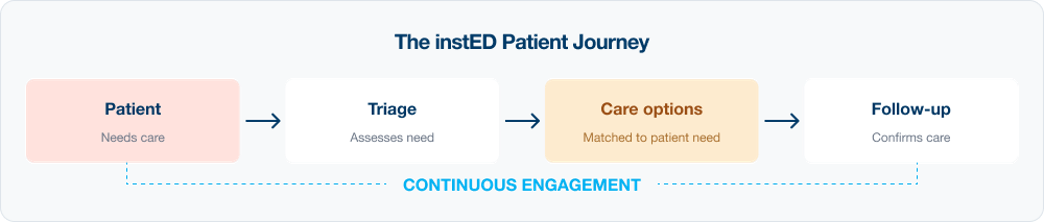
The model was purpose-built to support complex populations by integrating acute, episodic care into patients’ longitudinal care journeys, leveraging four core components.
RN-Led Clinical Intake, Triage and Follow-Up
instED operates a centralized Clinical Resource Center staffed by experienced registered nurses,mobile health coordinators and clinical support specialists. Using custom triage protocols, the team assesses each request to determine whether the patient can safely be treated at home via Mobile Integrated Health or telehealth, or if they should be navigated to another level of care, which could include redirection to primary or urgent care, escalation to an emergency department, or connection to other community-based care resources. The Clinical Resource Center also facilitates patient and PCP follow-up and communication, enabling post-visit continuity of care.
Local, EMS-Based Care Delivery Network
instED partners with local and regional Emergency Medical Services (EMS) agencies with dedicated Mobile Integrated Health units. Their mobile health providers are trained in community paramedicine and upskilled in the instED care model. These mobile health providers deliver in-home medical evaluation and treatment under virtual medical control supervision. By partnering with local community paramedics and EMS professionals, instED has been able to quickly and nimbly expand access to care-in-place services across multiple states.
Expert Virtual Medical Control
Every instED mobile integrated health encounter operates under physician- and NP-directed Virtual Medical Control (VMC), with board-certified physicians and nurse practitioners available in real time by phone or video to support field clinicians. This model enables rapid escalation, consultation, and treatment planning during in-home visits. For patients whose needs can be appropriately managed remotely, instED may also offer telehealth services, reducing the need for an in-person response when clinically appropriate.
Proprietary Technology Platform
The instED NOW platform serves as the operational backbone of the model. This cloud-based platform provides phone, portal, and app-based entry points for patients, clinicians, and care teams. Powered by the athenahealth electronic medical record and using a rule-based, machine-learning engine, instED NOW enables informed triage and dispatch, real-time coordination, clinical documentation, and post-visit data sharing with providers and health plans.
Together, these elements allow instED to function as a viable alternative to the emergency department for non-emergent needs, bringing complex care capabilities to the patient rather than the patient unnecessarily defaulting to the ED.
The model provides:
- Dynamic, personalized care in place
- Timely, reliable access to care when other options aren’t available
- A solution for transportation barriers
- Improved patient and caregiver experience
- Continuity of care
Proven Outcomes
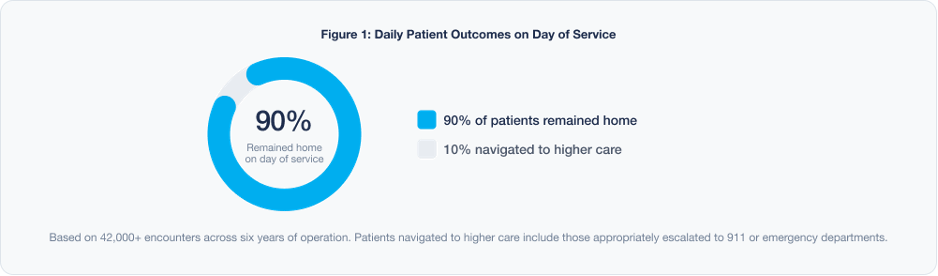
Across all payer types, instED has completed more than 50,000 encounters with over 15,000 patients, with approximately 90 percent of encounters resulting in patients remaining home on the day of the visit.
An Episodic Solution with Long-term Impacts
In a recent analysis conducted with a large client, instED evaluated utilization patterns among 2,100 instED patients during the 90 days before and after an instED encounter.
The study found significant reductions in emergency department and hospital utilization following instED intervention, including:
- 19 percent reduction in ED visits among frequent ED utilizers
- 6 percent reduction in inpatient admissions for that same cohort
- 11 percent reduction in ED visits among patients with serious mental illness
- 12 percent reduction in inpatient admissions for that group
- 5 percent reduction in ED visits among members in clinical case management
- 8 percent reduction in inpatient admissions for those members
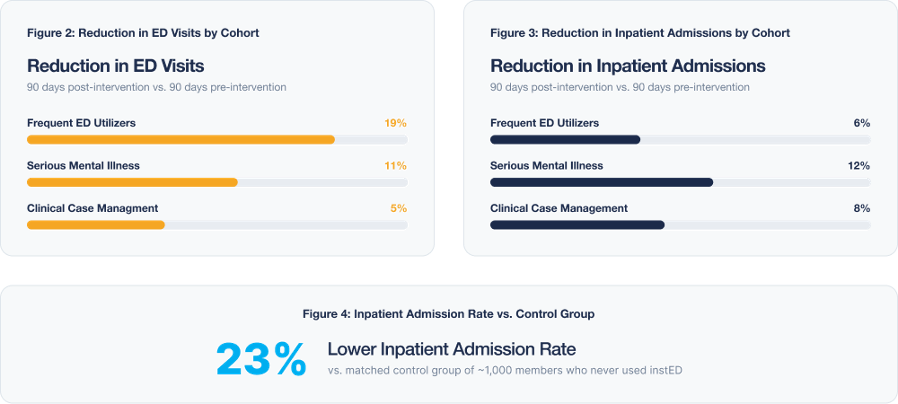
Additional cohorts, including patients with COPD, chronic kidney disease, and neurodegenerative disorders, showed similar improvements. Compared with a matched control group of approximately 1,000 members who had never used instED services, the instED patient population demonstrated a 23 percent lower inpatient admission rate in the 90 days following intervention.
Predictable Cost Savings
By preventing unnecessary emergency department visits and hospital admissions, instED delivers measurable cost reductions for payer and risk-bearing partners. As multiple analyses have shown, identifying the right patient cohorts are key to driving significant outcomes.
When factoring in emergency department and ambulance transport costs, instED estimates savings of more than $1,000 per encounter after the cost of the visit.
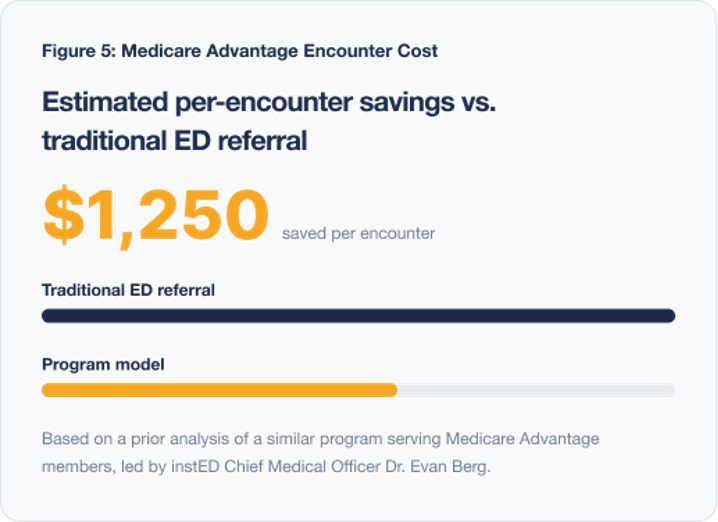
Past analysis of a similar program serving Medicare Advantage members, led by instED Chief Medical Officer Dr. Evan Berg, yielded comparable results, estimating a per-encounter cost savings of $1,250 compared to the traditional emergency department referral model.7
Exceptional Patient Experience
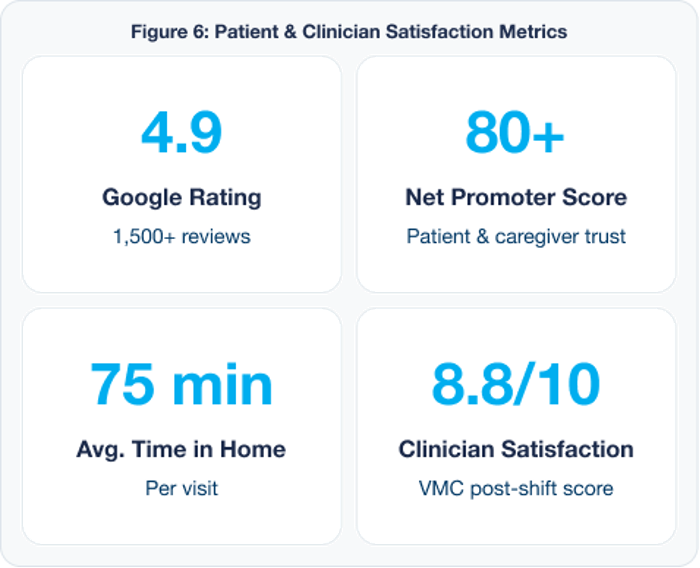
instED maintains a Net Promoter Score above 80 and has earned a 4.9 Google rating across more than 1,600 reviews, reflecting strong trust among patients and caregivers.
Patient satisfaction is supported by the timeliness, quality, and depth of each visit. In 2025, instED completed more than 12,500 encounters involving over 5,500 unique patients. Of these visits:
- Mobile health providers arrived within 90 minutes on average for Priority 1 cases, with an overall average arrival time across all acuity levels of less than three hours.
- instED clinicians spent an average of 75 minutes in the home, allowing for comprehensive evaluation, treatment, and care coordination.
Broad Range of Patient Acuity and Complexity
Since expanding beyond its parent health plan in 2019, instED has grown to serve multiple organizations across New England and the Pacific Northwest. Today, instED works with 14 payer groups across Massachusetts and Oregon, including:
- Managed care organizations
- Risk-bearing Accountable Care Organizations and Clinically Integrated Networks
- D-SNP, FIDE-SNP and Medicaid waiver programs
- Programs of All-Inclusive Care for the Elderly (PACE) organizations
- Complex care management services
- EMS-based MIH programs
This diverse payer participation reflects the broad applicability of the model across risk-bearing healthcare organizations. In an analysis of 12 months of claims, 51 percent of diagnosis codes treated by instED aligned with the top ten treat-and-release conditions seen in emergency departments,8 demonstrating that the model effectively addresses the types of cases that frequently drive emergency department utilization.
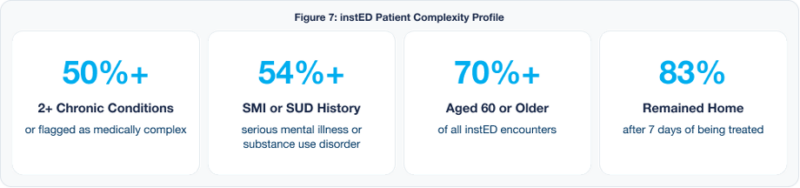
While instED intervention has a wide variety of use cases, their care model is particularly well-suited for medically complex populations. An analysis of 13K encounters over a 12-month period for a dually eligible population showed:
- More than 50 percent of patients had two or more chronic conditions or are flagged as medically complex
- More than 54 percent of encounters involved patients with severe and persistent mental illness or substance use disorder histories
- Over 70 percent of instED encounters involved patients aged 60 or older
Of this subset, 90% of encounters resulted in the patient remaining home on the day of the visit. After 7 days, 83% of those treated remained home and had not presented to the ED. This demonstrates the capability of the instED model to address the needs of the highest-risk, highest-complexity cohorts within any population, regardless of payer type.
Technology-Enabled Care Coordination and Engagement
instED was built to ensure that patients receive timely, tailored care for complex acute needs, and afterwards, they are connected seamlessly with their longitudinal care teams.
The instED NOW technology platform is the hub connecting all spokes of the decentralized care model and has been well-received by the instED user community. In 2025 alone:
- 78.7 percent of provider requests were submitted through the instED app or portal
- 471 unique providers referred patients
- Hundreds of health plan care managers actively used instED NOW
This level of engagement demonstrates strong adoption amongst providers, care teams and mobile health providers, who rely on the instED NOW platform for:
- Phone and web-based request options for patients and providers, with timely updates on the visit request status
- Clinical Resource Center triage and dispatch workflows, backed by instED’s Decision Support (iDS) Engine designed to standardize and scale service delivery through machine learning
- Efficient assignment and dispatch of mobile health providers based on geotracking
- Mobile health provider and VMC communication by phone, video and secure messaging
- Integration with AI-enabled tools that curate and filter insights from Health Information Exchanges, providing instED’s VMC providers with up-to-date, relevant patient insights
- Real-time transfer of visit documentation to primary care providers, care managers, and health plans once visits are complete; encounter summaries are sent via eFax or EMR direct address after chart completion, as well as pushed into Health Information Exchanges
Partnering for Success
Many care-in-place solutions focus narrowly on specific use cases, address singular diseases or conditions, or emphasize logistics or technology alone. instED is built to intervene upstream, to meet patients in their time of need and offer a front-door solution for care navigation, decision-making and tailored care delivery, rather than a niche service with a single effector arm.
That’s why instED aims to partner with organizations looking to take a population health approach to over-reliance on the emergency department. instED is differentiated by its ability to:
- Meet patient needs with advice, navigation, telehealth and care-in-place solutions
- Accurately triage patients to the right setting of care
- Deliver same-day and prescheduled in-home care when appropriate
- Serve diverse populations with complex needs, across payer types
- Integrate directly with existing care teams and health plans
- Nimbly and quickly scale through partnerships with local EMS outfits
- Provide multi-faceted engagement support to ensure staff and patient uptake
instED is entering its next phase of growth with a focus on scale, integration, and deeper value-based alignment.
Performance-based Contracting
instED continues to expand partnerships with Medicare Advantage plans, Medicaid managed care organizations, ACOs, PACE programs, and self-insured employers, shifting emphasis from fee-for-service to risk-based arrangements, capitated models, and population health partnerships.
Geographic Expansion
The company is exploring growth through Mobile Integrated Health and EMS partnerships, enabling regional and national expansion while maintaining clinical quality and operational consistency.
Expanded Triage and Care Delivery Options
Future programs will focus on engaging high-risk patients earlier in the care cycle to prevent avoidable utilization and improve long-term outcomes through prescheduled visits, as well as meeting needs across a wider acuity spectrum with telehealth and nurse advice options, in addition to the Mobile Integrated Health response.
Enhanced Navigation and Community Connections
To reduce the likelihood of returning to the emergency department after an instED visit, the company is implementing enhanced follow-up capabilities, including navigation and referral to community assistance, including behavioral health providers, social services and other resources to address the social drivers of health that often lead to ED utilization and hospitalization9, as evidence shows that unmet health-related social needs are associated with up to a 1.5x higher repeat ED use than average.
The Path Forward
Over 50,000 encounters, more than 15,000 patients, and demonstrated reductions in emergency department and inpatient utilization amongst high-risk patient segments collectively demonstrate that instED is not a theoretical alternative to the ED. It is an operational one, validated across payer types, acuity levels, and medically complex populations.
The traditional episodic care model directs patients into emergency departments by default, generating avoidable costs, fragmenting continuity, and straining a system already under significant pressure. instED offers a different pathway. It places clinical triage and navigation, in-home treatment, physician and nurse practitioner oversight, and care coordination into a single integrated episode, delivered where the patient already is.
For payers and risk-bearing organizations, instED provides a scalable mechanism to reduce total cost of care while prioritizing clinical quality, continuity of care, and member experience. For providers and care managers, it extends their reach into acute episodes that would otherwise occur outside their visibility. For patients and caregivers, it brings dignity, access, and trust to a moment that the current system has made unnecessarily disruptive.
Massachusetts’ MIH regulatory framework reflects the growing evidence that many patients with complex and even potentially high-acuity conditions can be safely and effectively assessed, treated, and managed outside the ED when appropriate protocols, medical oversight, and escalation pathways are in place. What remains is the opportunity for systems, plans, and providers to integrate this capability into the broader standard of care.
The next chapter in expanding access to reliable, timely care for complex patients extends beyond the walls of the emergency department. instED is already helping to write it.
Citations
- Mireles-Romo C, Hernandez E, Choi I, Roh J, Saadat S, Toohey S. Exploring Factors That Drive Nonurgent Emergency Department Use. J Patient Exp. 2025 Jul 23;12:23743735251362529. doi: 10.1177/23743735251362529. PMID: 40718463; PMCID: PMC12290403.
- https://www.bluecrossmafoundation.org/sites/g/files/csphws2101/files/acquiadam-assets/Foundation-OB3-WorkGroup-CalltoAction-FINAL.pdf
- https://www.unitedhealthgroup.com/content/dam/UHG/PDF/2019/UHG-Avoidable-ED-Visits.pdf
- https://www.cdc.gov/mmwr/volumes/71/wr/mm7101a6.htm
- 2026, American Hospital Association, via KFF.
- Uscher-Pines L, Pines J, Kellermann A, Gillen E, Mehrotra A. Emergency department visits for nonurgent conditions: systematic literature review. Am J Manag Care. 2013 Jan;19(1):47-59. PMID: 23379744; PMCID: PMC4156292. Durand AC, Gentile S, Devictor B, Palazzolo S, Vignally P, Gerbeaux P, Sambuc R. ED patients: how nonurgent are they? Systematic review of the emergency medicine literature. Am J Emerg Med. 2011 Mar;29(3):333-45. doi: 10.1016/j.ajem.2010.01.003. Epub 2010 Apr 24. PMID: 20825838.
- E. Berg, D. Estrella, V. Patsiogiannis, et al., “Emergency Department in Home (EDiH): A Novel Approach to Delivering Acute Care,” NEJM Catalyst 5, no. 7 (2024): CAT.23.0374,
- AHRQ Statistical Brief #286, Most Frequent Reasons for Emergency Dept. Visits, 2018. https://hcup-us.ahrq.gov/reports/statbriefs/sb286-ED-Frequent-Conditions-2018.pdf
- https://pmc.ncbi.nlm.nih.gov/articles/PMC11956181/