



In-Home Emergency Care in Oregon: instED Joins Mercy Flights
Read Time: 5 min
What is changing for rural healthcare in southern Oregon?
In-home emergency care in Oregon is expanding through a new partnership between Mercy Flights and instED. Mercy Flights received a Catalyst Grant Award from the Oregon Health Authority through the Rural Health Transformation Program to support its In-Home Emergency Care with Medical Transport to Alternate Destinations initiative.
The award period runs from July 1, 2026, through September 30, 2028. Mercy Flights selected instED as a care partner for the initiative, bringing together local emergency medical services and a coordinated clinical model designed to help eligible patients receive care in the right setting.
Why does the Catalyst Grant matter?
The Catalyst Grant gives Mercy Flights a defined implementation period for expanding a locally led care model. It supports more than a single service line. The initiative connects assessment, treatment, transportation decisions, and follow-up around the patient’s needs.
That connection is essential in rural delivery systems. A home visit must still include clinical accountability, communication, and an escalation route. By combining Mercy Flights’ regional operations with instED’s navigation and medical oversight, the partnership can build those safeguards into each eligible encounter.
How will the in-home emergency care model work?
The model gives clinicians more options when a patient needs timely evaluation but hospital emergency department services are not required. Specially trained clinicians can assess and treat eligible patients at home, then help connect them with an appropriate destination or follow-up service.
The program combines four connected capabilities:
- Local response from Mercy Flights clinicians
- Nurse navigation through instED’s clinical resource model
- Telehealth physician support during care delivery
- Technology-enabled coordination across the care team
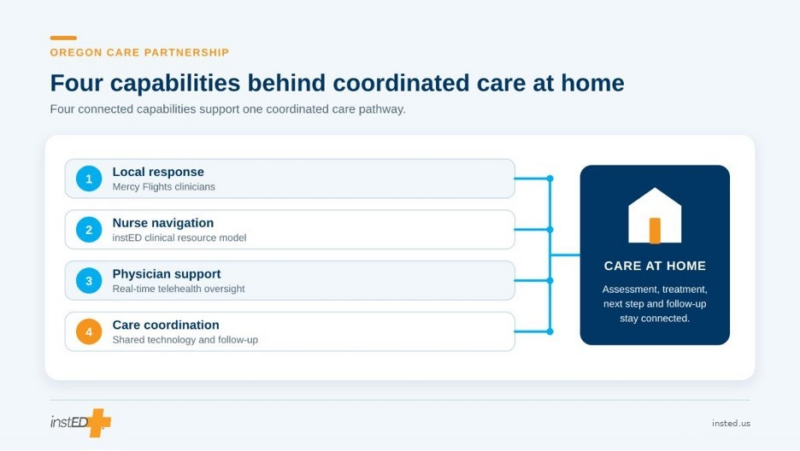
Four connected capabilities behind coordinated care at home.
These capabilities support a more continuous experience from the initial request through treatment and follow-up. The model also aligns with instED’s work to extend care beyond the medical office while keeping the patient’s regular providers informed.
What role does instED play in the partnership?
instED supports the clinical and operational infrastructure behind care in place. Its nurses help navigate each case, physicians provide virtual medical control, and its technology helps participants work from shared information as care moves forward.
“Mercy Flights has a long history of championing the impacts of care in place, and we admire their leadership in rural health innovation,” said Don Stiffler, CEO of instED. “We’re proud to work alongside them to serve Oregonians through this program.”
The collaboration extends instED’s experience as a Mobile Integrated Health partner for organizations managing complex patient needs. It also builds on the company’s broader work bridging access gaps for patients with complex health needs.
Why does care in place matter for rural communities?
Care in place can expand access without treating every request as a hospital-bound event. Rural communities often rely on limited clinical capacity across large service areas. A coordinated model helps local teams use that capacity more intentionally while preserving hospital resources for patients who need them.
The federal Rural Health Transformation Program supports state-led approaches that improve access, coordinate care, strengthen rural workforces, and move appropriate services into lower-cost settings. Mercy Flights’ initiative puts those goals into practice through a locally led partnership.
For patients, the benefit is a clearer path to appropriate care. For clinicians, it is access to navigation, physician support, and coordinated information. For communities, it is a care model designed around local needs rather than distance from a hospital.
What comes next for instED and Mercy Flights?
The partners will focus first on implementing the funded initiative in southern Oregon. The work will connect Mercy Flights’ regional experience with instED’s care-in-place infrastructure and clinical support.
That combination creates a practical foundation for broader rural health collaboration. instED has previously supported Mobile Integrated Health expansion across state lines, and the Oregon partnership adds another locally grounded model for delivering care closer to home.
Mercy Flights’ official announcement provides full details about the Catalyst Grant Award and program.