


Five Strategies to Expand Palliative Care in Safety-Net Populations
Read Time: 7 min
Will Kennedy, DO; Lauran Hardin, MSN, RN-BC; Anne Kinderman, MD; Diane E. Meier, MD; John Loughnane, MD; Angelo Volandes, MD
Vol. 1, No. 2 | February 19, 2020
DOI: 10.1056/CAT.20.0004
Clinicians need to reexamine how they care for safety-net populations, especially when vulnerable patients are living with life-limiting conditions. This article presents five strategies for building robust palliative care programs that can improve outcomes for these populations: utilizing lay health workers, addressing gaps in care and setting goals of care, creating specialized interventions, shaping interdisciplinary teams for resilience, and addressing opioid-related challenges.
Paul’s medical story initially appeared straightforward. At 40 years old, he had metastatic lung cancer and had recently suffered a myocardial infarction. His disease was incurable. Yet behind the clinical facts was a far more complicated reality. He had repeatedly been documented as leaving hospitals “against medical advice,” but there was little effort to understand why.
Paul had grown up in poverty and had experienced abuse early in life. After marrying his high school sweetheart, his life began what he described as a “slow-motion downward spiral” involving substance use, divorce, and estrangement from his children. By the time he was diagnosed with cancer, he was working odd jobs and living in a hotel. Though he once joked that he had “made it out alive,” he was now dying—and doing so alone.
Before anyone took the time to fully explain his prognosis or discuss treatment options with him, Paul underwent aggressive chemotherapy. The complications were severe, including a heart attack. After a prolonged hospital stay left him homeless, his providers told him there was “nothing more we can do for you.” Angry, abandoned, and with nowhere to go, Paul was left feeling discarded by the very system meant to care for him.
Even as his condition worsened, Paul remained defiant. He rejected hospice because he saw it as “giving up,” despite understanding that no curative treatment remained. Eventually, he accepted admission into a palliative care program not because he was ready to discuss end-of-life care, but because he had no home, no family support, and nowhere else to turn. The program’s willingness to first focus on what mattered most to him—a safe place to stay—became the foundation for rebuilding his trust in the medical system.
The Safety Net Often Fails the Most Vulnerable
Paul’s medical history may have predicted how he would die, but it said little about how he might still live with the right support. Sadly, his experience is not unique. Across the United States, safety-net hospitals and clinics serve large populations of Medicaid recipients, dual-eligible patients, uninsured individuals, undocumented communities, and other vulnerable groups. In California alone, nearly 30% of the population relies on the safety net, defined as individuals enrolled in public programs and earning less than 300% of the federal poverty level.
These communities often face disproportionate levels of trauma, behavioral health challenges, and social determinants of health that are beyond their control. When serious illness enters the picture, factors such as unstable housing, poor access to care, low health literacy, and limited financial resources can significantly affect both quality and cost of care. Without the power or support to advocate for themselves, many patients receive treatment that does not align with their values, needs, or goals.
To address these gaps, the authors outline five strategies to strengthen palliative care delivery for vulnerable populations.
Strategy 1: Utilizing Lay Health Workers
There is a significant shortage of palliative care professionals in the United States, including physicians, nurses, chaplains, social workers, and advanced practice providers. These workforce shortages are especially pronounced in safety-net settings, where specialty care has historically been under-resourced.
Lay health workers (LHWs), navigators, and similar support roles offer an important solution. Research has shown that specially trained LHWs can dramatically improve patient satisfaction, increase goals-of-care documentation, boost hospice utilization, and reduce emergency department visits and hospitalizations. These roles help fill gaps not only in clinical support but also in social care.
Lay health workers are particularly effective in three areas: building trusting long-term relationships, initiating advance care planning early, and identifying unmet social needs. In many ways, they serve as experts in “social diagnosis” and “social prescribing.” Through home visits and ongoing engagement, they can uncover challenges such as social isolation, lack of caregiving, food insecurity, and housing instability. These insights often reveal the root causes of repeated hospital use and allow care teams to intervene more effectively.
By connecting patients with community-based resources—such as caregiving support, food assistance, or housing services—LHWs help create a more person-centered model of care. This relationship-based approach often lays the groundwork for deeper trust and more meaningful medical decision-making.
Strategy 2: Addressing Gaps in Care and Setting Goals of Care
Goals-of-care conversations are central to serious illness care, but they often happen too late, focus too heavily on treatments rather than values, and assume a level of health literacy that many patients do not have. These challenges are even more pronounced in safety-net populations, where patients may be coping with urgent mental health concerns, trauma histories, or unstable living conditions.
A more effective approach combines trauma-informed care, motivational interviewing, and video-based decision aids.
Trauma-informed care begins with a simple but powerful shift in perspective: instead of asking, “What’s wrong with you?” clinicians ask, “What happened to you?” This framework recognizes that many patients living with serious illness have also experienced childhood trauma, abuse, discrimination, or prior harm within the health care system. Applying trauma-informed principles universally helps create safer, more respectful clinical encounters.
Motivational interviewing adds another layer by helping patients explore conflicting feelings and identify their own goals. Through open-ended questions, affirmations, reflective listening, and summaries, clinicians can create a supportive environment where patients feel heard and empowered. This is especially important when previous experiences have left patients feeling dismissed or misunderstood.
Video-based decision aids can further improve communication by making complex medical information easier to understand. Research shows that these tools can improve advance care planning, increase hospice referrals, and reduce in-hospital deaths—particularly among populations with limited health literacy.
Strategy 3: Creating Specialized Interventions
Conventional medical systems often fail to meet the needs of patients with serious illness who also face social and behavioral health challenges. Specialized interventions can fill these gaps.
One example is Commonwealth Care Alliance’s partnership model with hospice providers in Massachusetts. Rather than requiring patients to fully transition into hospice and lose their trusted primary care relationships, this model allows patients to continue receiving care from their established team while accessing hospice services on a flexible, fee-for-service basis. This “a la carte” model preserves continuity, reduces fear of abandonment, and has demonstrated cost savings.
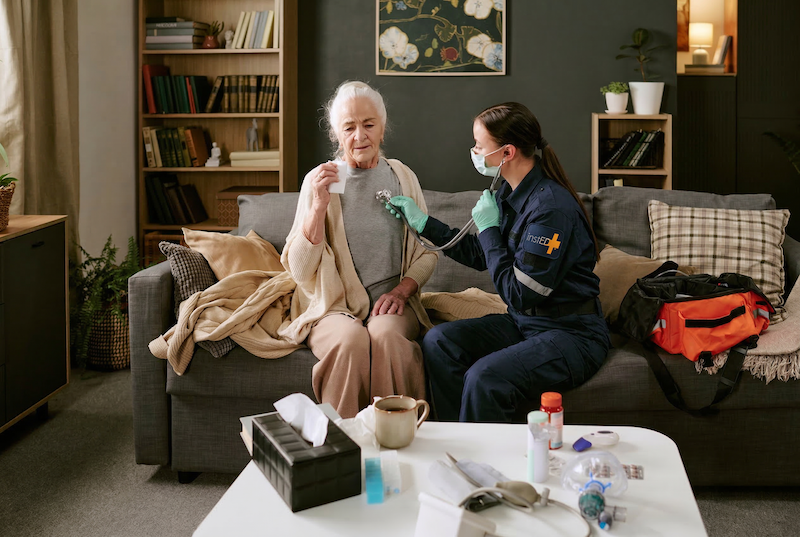
Another example is community paramedicine. Through programs like InstED, specially trained paramedics provide in-home urgent care for symptoms such as pain, dyspnea, or seizures—allowing patients to avoid unnecessary emergency department visits. These services can also address falls, caregiver distress, and other non-medical crises. The result is often improved patient stability, fewer hospital transfers, and meaningful cost reductions.
Strategy 4: Shaping the Interdisciplinary Team for Resilience Support
Clinicians working in high-need, high-trauma environments are at elevated risk of burnout and moral distress. Safety-net palliative care often exposes providers to repeated stories of suffering, isolation, and systemic failure. Without adequate support, this work can become emotionally overwhelming.
An interdisciplinary team model helps distribute this emotional burden and creates space for shared reflection and resilience-building. In these settings, concepts such as patient-defined dignity, non-abandonment, bearing witness, and professional boundaries become essential.
Patients may define dignity in ways that differ from traditional medical expectations. They may choose to remain homeless, stay in unstable environments, or pursue aggressive treatment until the very end. Rather than trying to “fix” every circumstance, clinicians can shift toward “serving” patients—recognizing them as whole people deserving of respect and support.
Strong leadership is also critical. Teams benefit from rituals, debriefing, flexibility, peer support, and a culture that values effort over outcomes. In this environment, staff care becomes inseparable from patient care.
Strategy 5: Addressing Opioids
Any discussion of palliative care for safety-net populations must also confront the realities of the opioid crisis. Patients in these settings may have higher rates of substance use disorders, but they also experience significant pain related to serious illness. Balancing relief and safety requires a nuanced, individualized approach.
Too often, patients are either undertreated because of fear and bias or overprescribed without appropriate safeguards once they enter hospice care. Neither extreme serves the patient well.
A better model includes careful, relationship-based risk assessment and practical safety strategies such as lock boxes, limited medication supplies, urine drug screening, and close monitoring. Clinicians must also recognize that pain is multifaceted and may include emotional, existential, or trauma-related dimensions—not just physical symptoms.
Importantly, supporting staff is part of this strategy as well. Providers may struggle emotionally when patients make difficult choices, such as refusing safer settings for medication administration. These experiences require both clinical judgment and emotional support.
Revisiting Paul
In the end, Paul was not “noncompliant.” He was scared.
He did not leave the hospital “against medical advice” because he was difficult or defiant. He left because he had experienced abuse as a child, and certain hospital interactions triggered those memories. What had been labeled as poor behavior was, in reality, a trauma response.
Paul was never a “problem patient.” He was simply a patient—one who deserved to be seen and treated as fully human during one of the most vulnerable times of his life.
Like many others, Paul could easily have died the way he lived: isolated, neglected, and marginalized. Instead, he died peacefully in supportive housing, surrounded by providers he trusted. Near the end of his life, he said of his care, “I used to be falling, and now I am not.”
As health care providers, there is both a moral and financial responsibility to care for people like Paul. More importantly, doing so is possible.